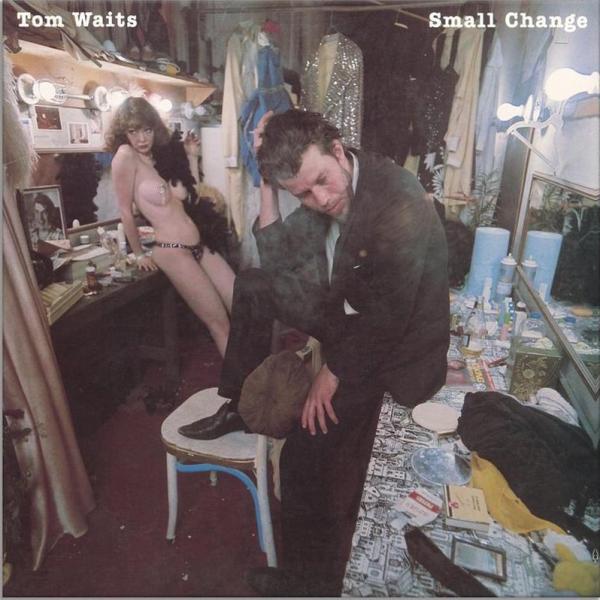
Tom Waits: Small Change
Album #221 - September 1976
Episode date - March 18, 2026

By the time “Small Change” hit the streets, Tom Waits had already been around for a while, honing his craft and sharpening his persona. We all knew that he was a character, but we had yet to learn that he could be his own panoply.
His previous three releases were all excellent introductions to a stunningly original new talent who had an ear to the street, but none of them displayed his full range. On “Small Change,” Waits doesn’t sing about his characters so much as he embodies them. Rather than observe and report, or sing as if narrating from the eye of the hurricane, he plunges head first into the storm.
No longer satisfied with simple streetwise observations, he creates a veritable full color document of street life, with dozens of fully formed characters providing the narration. Without compromise, “Small Change” captures bohemian street life (as opposed to simply portraying it), complete with humor, sadness, sex, loneliness, drunken nights and painful mornings in cheap diners.
The effect and after-effect of steady boozing provides continuity throughout the album. Alcohol informs every word and every note. Just like real life would be for a drunkard, it is alternately funny and then jarringly sad, with the stinging bite of desperation hiding around every corner, especially transparent in the deflective humor. Each song is a different perspective on skid row, with stories told by those who hit rock bottom and then answered by those who are riding a greased pole in that same direction. Moods shift drastically, depending on whether the character is fully lit or descending into hung-over melancholy.
Rock bottom is where the album opens. “Tom Traubert’s Blues” is a desperate tale of absolute loss and surrender, milking ‘Waltzing Matilda” for every ounce of inebriated pathos suggested by the World War I tune, as the character melts pathetically into the gutter and the wee hours give way to sunrise. “Step Right Up” could be the sound of a street hawker working the same alley on the following morning. “Jitterbug Boy” is a return to the pathetic side, portraying an old man’s bragging lament for a life that by implication is seeing much less action these days.
This is how the album moves, flipping its way through both sides of the same coin, with no forward progress. It’s an album of contradictions, with varied characters, all of whom seem incapable of catching a break even if it fell into their lap. Underneath the braggadocio and humor, there lies a self-awareness that perhaps it’s a bit too late to cash in on opportunity anyway.
On each track, there’s an implicit understanding that any lack of luck may be self-induced, and a bit of ‘small change’ may be the best that you can hope for. As Waits sings on “Jitterbug Boy”, “If it’s heads I’ll go to Tennessee, tales I’ll buy a drink. If it lands on the edge, I’ll keep talking to you.” Like a buffalo nickel spinning on its side, “Small Change” is an album of hard luck tales told from the edge.
Featured Tracks:
Tom Traubert's Blues (Four Sheets to the Wind in Cophenhagen)
Step Right Up
Jitterbug Boy
I Wish I Was in New Orleans (In The Ninth Ward)
The Piano Has Been Drinking (Not Me)
Invitation to the Blues
Pasties and a G-String (At the Two O'Clock Club)
Bad Liver and a Broken Heart (In Lowell)
The One That Got Away
Small Change (Got Rained on with His Own .38)
I Can't Wait to Get Off Work (And See My Baby om Montgomery Avenue)
September 1976 - Billboard Charted #89
Related Shows