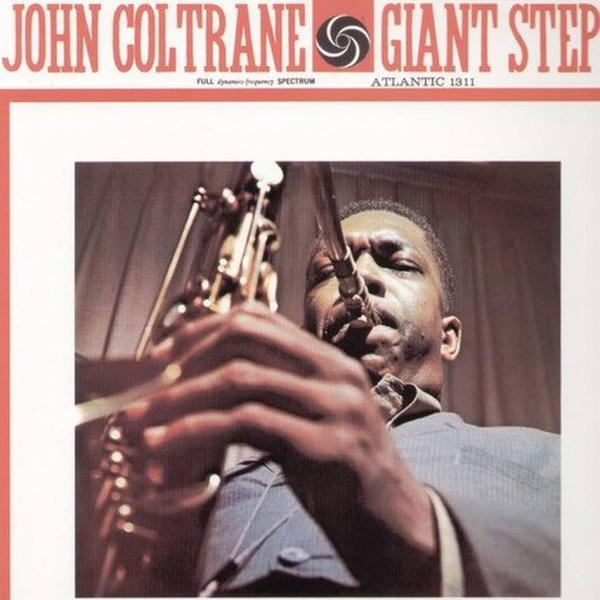
John Coltrane: Giant Steps
Album #33 - February 1960
Episode date - February 14, 2024

“Giant Steps” was not Coltrane’s first album as a bandleader, but it was his first for Atlantic Records, which was significant. The four albums he recorded for Prestige are fascinating documents of a fomenting genius, while his sole album for Blue Note proved his mettle as a benevolent leader, but “Giant Steps” lays out enough evidence to prove that the title stood for something.
At this point, Coltrane was already famous for his affiliation with Miles Davis, a relationship that defined them as opposites in many ways but incredibly compatible nonetheless. Both are products of Charlie Parker, but in different ways. Davis was a member of Parker’s band, and since Davis ran his own band, it must have irked Coltrane to some degree that he could take on Parker’s work and then some, playing circles around chord patterns with fascinating speed and dexterity, but still play second to a bandleading trumpeter who reveled in the space between the notes. Davis often complained of Coltrane’s tendency to play “too many notes”, but left to his own disposition, Coltrane felt free to fly, and on “Giant Steps,” he flew into the stratosphere.
When I was young, I used to hear “Giant Steps” as radically innovative, and in many ways it is, but is also conventional in more ways than I knew. Chronologically, this album competed for relevance with Davis’ “Kind of Blue” (which featured Coltrane), Charles Mingus’ “Ah Um” and Ornette Coleman’s “The Shape of Jazz to Come”, all of which were serious game changers for the future of jazz stylization. In comparison, “Giant Steps” was almost conventional. Each song starts by establishing a core riff, after which Coltrane takes off on one of his million-note solos - structurally, it’s not a stray from Parker’s method of establishing a theme and then reinventing it. The theme returns at the end, after a solo or two from the supporting players. Coltrane’s band is a four-piece, so the only other instruments that can solo are rhythmic, if you include the pianist (either Wynton Kelly or Tommy Flanagan). In other words, “Giant Steps” is a one-man show. Coltrane never lets go of the reins. Sure, he allows his band room to breathe, and gives them all a break here and there, but almost always he pounces back in, like an impatient leopard who can’t fathom allowing the pace to slacken. He simply has too much to say and he plays like he cannot waste a second.
As a bandleader, Coltrane sounds confident, fully in control and happy to be in the driver’s seat. His solos are definitive examples of textbook perfect playing (and often used as practice pieces for jazz horn players). The strength of his focus is enormous, resulting in the best playing of his career up until this point. You can literally hear his pride and his sense of purpose in every note that flies past your ears. He’s intense, determined and purposeful throughout. These traits are particularly apparent on the title track, which always leaves me wondering how he could manage to find the air that allowed him to play so many notes with hardly a pause. The songs themselves provide room for complex emotional variation, from the deeply moving “Naima” to the playfulness of “Syeeda’s Song Flute,” from the laid-back swing of “Cousin Mary” to the hare-brained intensity of “Countdown.”
Other albums may have been developing theories to change the direction of music, but “Giant Steps” precedes Coltrane’s step in that direction. As an album, it is a solo statement of purpose, and if judged as such, may be one of the strongest solo statements made by a jazz musician in decades.
Featured Tracks:
Giant Steps
Cousin Mary
Countdown
Spiral
Syeeda's Song Flute
Naima
Mr. P.C.
February 1960 – Billboard Did Not Chart
Related Shows