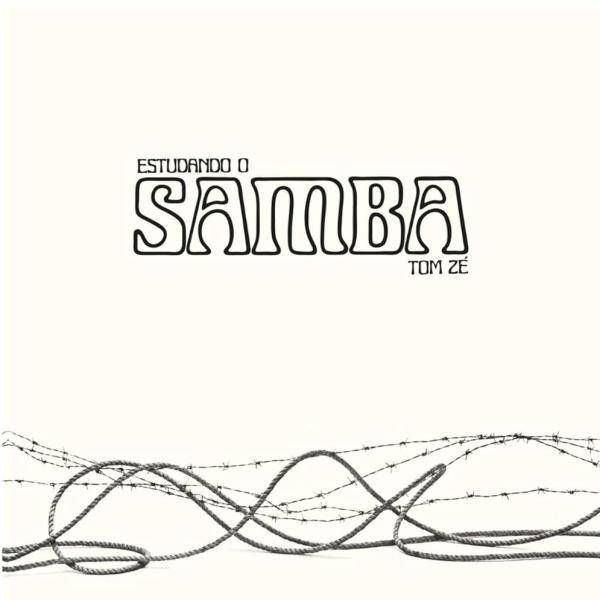
Tom Zé: Estudando O Samba
Album #219 - July 1976
Episode date - February 4, 2026

Like any good Dadaist, Tom Zé is a contrarian. He often invokes the dark side of existence with light humor. He pays respect to the music he loves by deconstructing it and turning it into something completely different.
Tom Zé (rhymes with ‘meh’) was a key protagonist of the Tropicalia movement, bringing much needed perspective to the iconoclastic cast of characters in search of common ground both musically and politically. He was raised in Northeast Brazil, so far from a city that he once claimed his childhood was “pre-Gutenburg”, since he lived without electricity or running water and almost all news and communication was spread verbally.
When he heard music on the radio, he was transfixed, and quickly set out to create his own, which in some cases also meant building his own instruments, and relocation to a population center like Rio de Jeneiro. Life in the city was startling to Zé and much of his music of that time addressed what he saw as the absurdities of modernism.
As Tropicalia became a movement, Gilberto Gil and Caetano Veloso emerged as stars and eventually, exiles, but Zé retained a fierce sense of independence, releasing experimental projects that confounded the oppressive government, but also alienated an audience who found his approach too cranial for pop music. By the mid-seventies, Zé was all but forgotten in Brazil, and virtually unknown anywhere else, but even in obscurity, he continued to create challenging art.
In 1976, Zé released his fifth album, which was greeted with profound indifference by the public and the press. Entitled “Estudando o Samba,” (“Studying Samba”), he poured his passion into manipulation of the samba form, utilizing his penchant for wordplay and wry wit for the album’s lyrical base. Eventually, the album vanished, as did Zé, who released only two poorly received albums over the next fifteen years. His career as a musician certainly seemed to be a thing of the past, and Zé was considering taking a job a gas station attendant when, in a manner that must have perfectly suited his artistic perspective, something completely absurd changed his fate.
In the late ‘80s, David Byrne of the Talking Heads became heavily involved with ‘World’ music, and he found himself particularly drawn to the sounds from Brazil. Starting his own label imprint, Byrne searched through Brazil’s cutout bins for music that would hold international appeal. In his search, he happened upon “Estudando o Samba”, and fell in love with the album. More than a decade after its release and dismal fate, Byrne found an album that not only sounded contemporary, but one that matched his own sensibilities.
With its layers of syncopation, vocal counterpoint and offbeat percussion, the opening track “Mā” could have fit seamlessly onto Talking Heads “Remain in Light.” Zé’s use of unusual production techniques and instrumentation on “Toc” would have blended perfectly with “My Life in the Bush of Ghosts,” Byrne’s project with Brian Eno. These songs existed before Byrne ever released an album! Here was an obscure likeminded artist with a deep vein of material that had been virtually ignored, making it perfect for Byrne’s Luaka Bop imprint. A Tom Zé overview disk was compiled, and suddenly Zé found himself lauded artistically, with a reputation that now reached the United States and Europe.
“Estudando o Samba” provided the lion’s share of material on Byrne’s compilation of Zé’s work, but the songs work much better in their original assemblage. On the 1976 album, Zé organizes the material in logical format, opening with a statement of purpose of sorts with “Mā”, which demonstrates the rhythmic thrust of his “studies”. He then moves on to a song written by Bossa Nova greats Jobim/de Moraes entitled “A Felicidade” (the only song not written by Zé on this album), perhaps because of its principal theme. “Sadness never ends, happiness does” fits comfortably with Zé’s own contrarian sensibilities. After an instrumental piece that further dissects his rhythmic obsessions, he offers a song simply titles “Tô” (“I’m”), which consists entirely of contrarian lyrics such as (translated from Portuguese, of course) “I’m explaining to confuse you, I’m enlightening you so I can blind you…eyes closed to see you better…I am desperate to have patience”. This playful, literate artistry continues unabated for the entire album until, perhaps to deliberately deflate everything he has achieved, the album ends with a blunt, short piece entitled “Indice” (Index), which literally indexes each of the song titles in the order of their appearance on the album! Who else but Tom Zé would do such a thing? And to think that all of this monumental work would remain virtually unheard were it not for David Byrne’s obsession is both sad, and wonderful.
Feature Tracks:
Mã
A Felicidade
Toc
Tô
Vai (Menina Amanhã de Manhã)
Ui! (Você Inventa)
Doi
Mãe (Mãe Solteira)
Hein?
Só (Solidão)
Se
Índice
July 1976 – Billboard Did Not Chart
Related Shows

Nuggets: Original Artyfacts from the First Psychedelic Era, 1965-1968 (Part 2)
Album #157 - June 1972

Nuggets: Original Artyfacts from the First Psychedelic Era, 1965-1968 (Part 1)
Album #157 - June 1972


David Bowie: The Rise and Fall of Ziggy Stardust and the Spiders from Mars
Album #153 - June 1972