Ege Bamyasi: Can
Album #163 - November 1972
Episode date - December 15, 2021

It’s not hard to understand why Can’s album catalog would remain obscure, despite near universal critical acclaim. Superficially, they are quite difficult to approach and even harder to appreciate.
I had been vaguely familiar with the band for years, but never considered them to be much more than pompous art-noise. First of all, their approach to music was thoroughly unconventional, with a complete disregard for standard song form. Secondly, the lyrics/vocals are entirely impossible to discern – I didn’t even realize that they were sung in English – and the style is so unconventional that it is easy to dismiss as amateur ranting…which, as it turns out, is more or less exactly what it is (more on that later). Before once again dismissing them offhand, I decided to listen closely to their catalog – this time with headphones - while reading the back-story to the band’s existence.
Here’s what I’ve learned. Irmin Schmit and Holger Czukay were students of the 20th Century European classical music scene, but it was hard to ignore the fact that the ‘new’ classical music was hardly representative of contemporary culture. Avant-garde minimalism and atonality provided the basis for the new classical world, but the public certainly did not embrace the new style. Artists like Stockhausen (who both had studied under) and Boulez functioned in rarefied air. Schmit traveled to Manhattan, and happened upon Andy Warhol’s art scene. In his own words, his notion of music was ‘corrupted’ by this trip, causing him to consider the possibilities presented by utilizing rock music as a new color in his musical palette. Thus was born the fundamental basis of what would come to be known as ‘Krautrock’.
Schmit returned to Germany, where he and Czukay teamed up with free-jazz drummer Jaki Leibezeit. An American vocalist named Malcolm Mooney rounded out the group for their early releases, until the intensity of Can’s music caused him to quit, leaving the band without a singer. The band’s second vocalist, Damo Suzuki, was discovered while busking his way across Europe. Jaki Leibezeit and bassist/engineer Holger Czukay came upon him and spontaneously decided to recruit him. He performed that very night, improvising in loose English over the band’s improvised rhythms. The ‘classic’ lineup was now set. Together they released “Tago Mago”, an incomprehensibly sprawling double album full of dense sound collages that could be simultaneously intriguing and also vaguely annoying. Only by listening with a pair of good headphones did the real qualities of “Tago Mago” reveal themselves.
“Ege Bamyasi” was their follow-up, and as a single album, it streamlines the excesses of “Tago Mago”. By no means conventional, it nonetheless is easier to digest than its processor by placing emphasis the band’s strong points. The drumming of Jaki Leibezeit is relentlessly driving, especially for music that is essentially spontaneous. His playing provides form and power to the non-structure of each composition. Fans of Journey’s Steve Perry or Earth, Wind and Fire’s Philip Bailey will recoil in horror at Damo Suzuki’s version of what constitutes a “lead singer”, but once you wrap your head around it, it’s hard not be drawn in to his provocative ‘anti-style’. The most stunning quality, though, is the engineering skills of bassist and recording engineer Holger Czukay. Czukay is plainly a genius with a recording console, as my headphone listening experience plainly demonstrated. I’ve never heard such rich three-dimensional sound from a mid-20th century pop album. You feel as though you are literally sitting in the drum stool, while the mad genius throws sound in every direction like an aural pop-art painter.
“Ege Bamyasi”” is definitely not an album that will work at parties. It’s anathema to casual listening. It’s outsider status provides a significant amount of its appeal, which would explain why Stephen Malkmus (Pavement), Thurston Moore (Sonic Youth) and Geoff Barrow (Portishead) all consider “Ege Bamyasi” to be one of the most influential albums on their own careers. The band Spoon even took their name from the album’s closing track. “Ege Bamyasi” is created as a one-on-one experience and it will never be an ‘easy’ listen, but patience is a virtue that may help to reveal the magic hiding within.
Tracks Featured:
Pinch
Sing Swan Song
One More Night
Vitamin C
Soup
I'm So Green
Spoon
November 1972 – Billboard: Did Not Chart
Related Shows


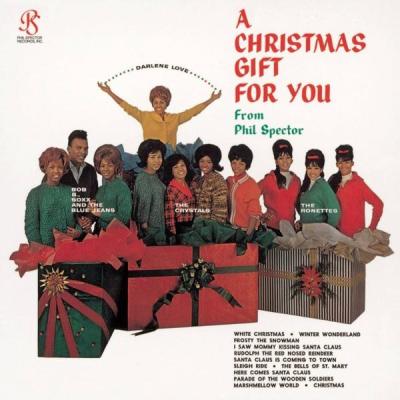
A Christmas Gift to You from Phillies Records: Various Artists
Album #40 - November 1963